
Measuring AI's Economic Reach: A Multi-Dimensional Task Taxonomy
1Canary Institute · 2Center for Economic Research, George Washington University
Abstract
Existing frameworks for measuring AI's labor market exposure decompose imperfectly across distinct dimensions: whether AI can perform a task, whether deployment is physically feasible, and whether institutions permit it. We propose CDR, a three-axis ordinal taxonomy that separates these dimensions into Cognitive complexity (C0–C4), Deployment difficulty (D0–D4), and Regulatory restrictions (R0–R4), extending Autor's (2003) routine/non-routine × cognitive/manual framework into a finer-grained classification space suitable for measuring AI exposure.
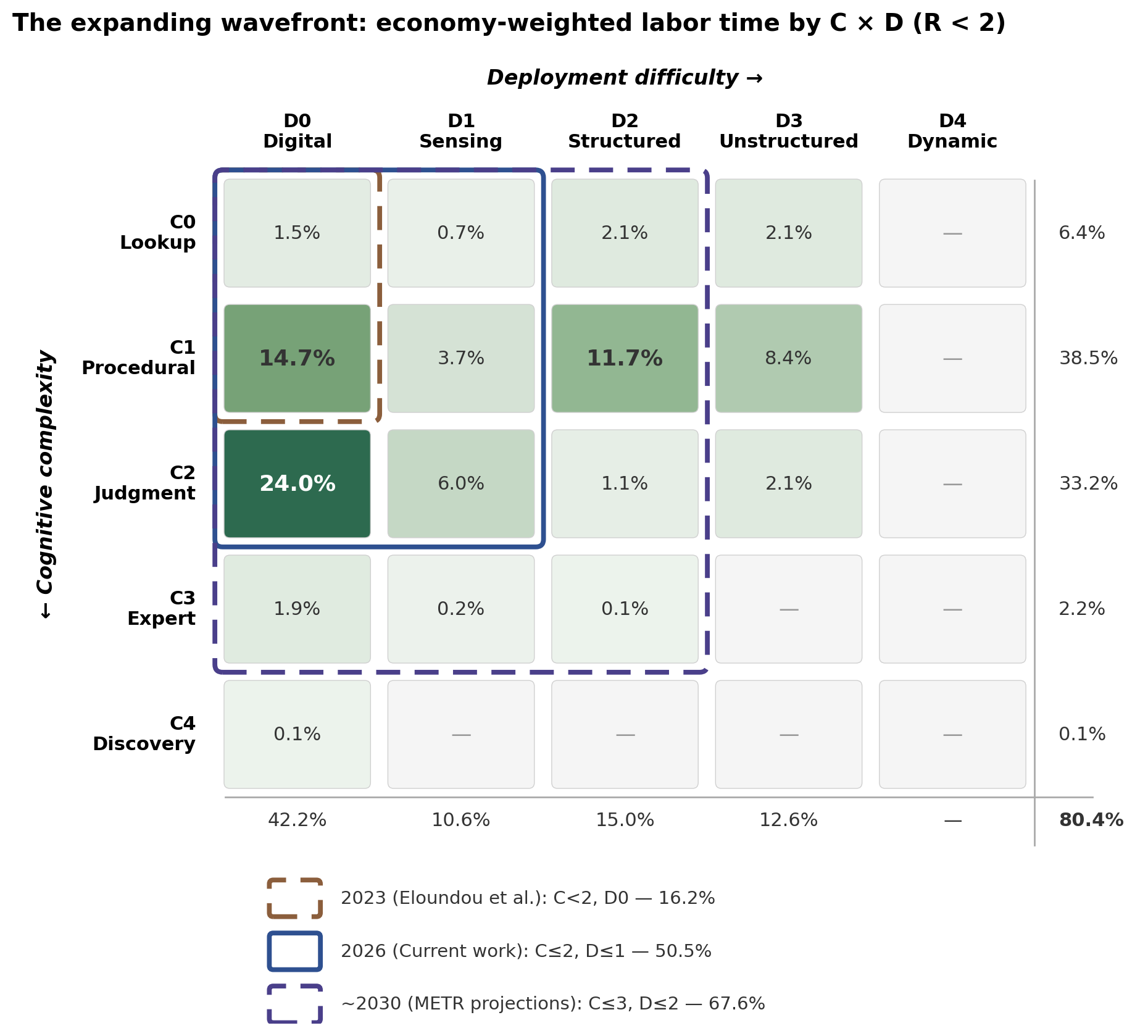
Applying CDR to the full O*NET task universe (23,850 task-activity pairs across 923 occupations, classified via multi-model LLM consensus: Claude Sonnet 4.6, GPT-5-mini, Gemini 3 Flash, validated against flagship models), we find that 40.2% of U.S. economy-weighted labor time falls in tasks that are within current AI cognitive reach (C≤2, up to and including contextual judgment), require no physical infrastructure (D0), and face no professional or statutory regulatory barrier (R < 2). An additional 19.6% of economy-weighted labor time is blocked by professional standards (R2: 11.5%), statutory regulation (R3: 8.0%), or moral agency requirements (R4: 0.1%).
Unlike exposure measures repurposed from other frameworks, which conflate cognitive capability with deployment feasibility and regulatory permissions, the CDR taxonomy was designed from the outset to decompose these independent dimensions, avoiding the dimensional conflation that produces disagreement across existing metrics. The three axes are empirically separable and advance at different rates, with implications for how capability, deployment, and regulatory changes affect exposure estimates independently.
 Click to enlarge